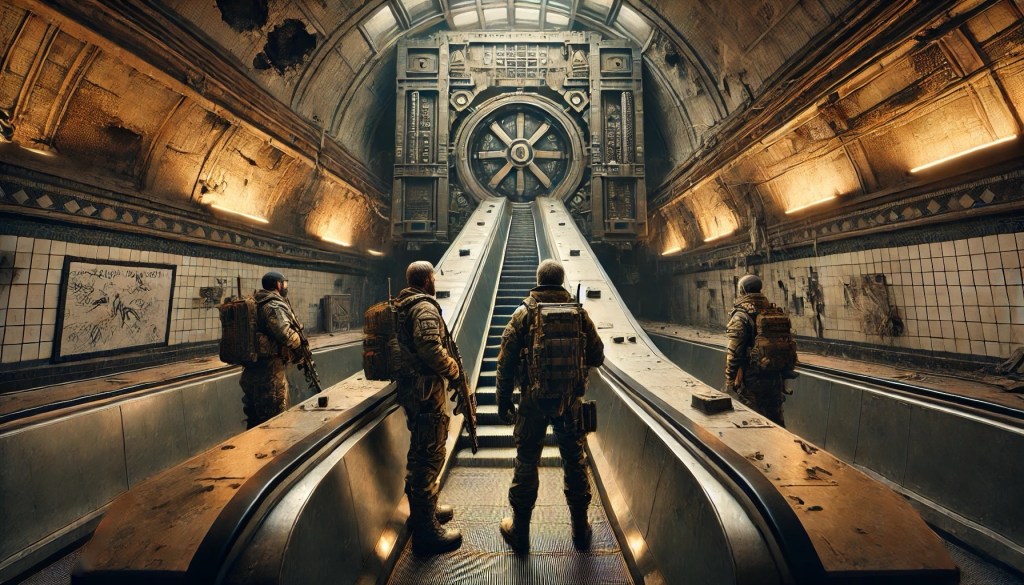
In Chapter 4 of London Tube 2033, titled “We Have Returned”, we follow Harvey as he reenters a long-familiar tunnel — a route he knows with the precision of someone who has memorised every inch through repetition, discipline, and blood. This is not just a mission. It is a return to origins, to the very ritual of survival etched into the bones of London’s buried arteries.
The chapter begins with Harvey alone, moving through a gallery where the air is dense, saturated with silence and mineral decay. Darkness does not frighten him anymore; it has become a companion, intimate and constant. As he walks, memories surface: his training as a young recruit, the brutality of early missions, the camaraderie reduced by attrition, and the law instilled by his instructors — “Don’t shoot if you want to stay alive.” It was not advice. It was doctrine.
What follows is a vivid recollection of his final training exercise — a harrowing joint mission through the unstable tunnel between North Greenwich and Canary Wharf. He and one other recruit survived where five others did not. Together, they ventured into the unknown, driven not by hope but necessity. The city above, still frozen and desolate after years of devastation, reveals itself not as a ruin, but as a thing transformed — unfamiliar, silent, stripped of memory.
When they emerge into the remnants of the surface near West India Quay, it’s not a reconnaissance but a crucible. The environment is savage: ice-laden wind, snow thick with ash and debris, biting through armour and filters. Harvey and his partner are no longer scouts. They are witnesses to a dead civilisation and agents of what must come after. Their journey is not only about traversing physical terrain but crossing into psychological darkness, where each step demands more than just endurance — it demands acceptance of isolation, loss, and purpose without promise.
By the chapter’s end, Harvey is alone with his companion, navigating a city that no longer recognises them, with no certainty of return. The enemy is no longer visible. The real threat is the silence, the cold, and the city itself — watching, waiting, without face or mercy.
It is not heroism that moves them forward.
It is obligation.
 London Tube 2033